 Golden Sprouts
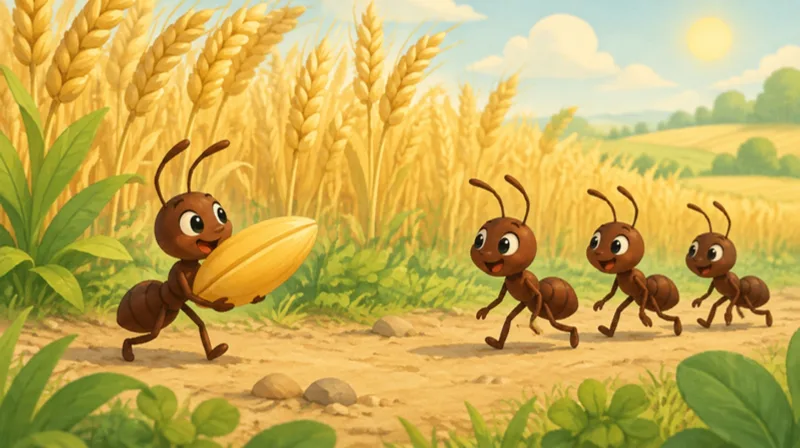
One sunny morning, Noura the ant went out to look for food. At the edge of the field she found a big grain of wheat.
Noura was delighted. This will feed us for days!
she said. She tried to lift it by herself, and the grain fell. She tried a second time, and it fell again.
Noura sat down to think. The grain is heavier than I am. But our home will need it in winter.
She went to her friends and said, I found a big grain. Will you help me?
Three ants came, and together they carried the grain, step by step.
When they reached home, Noura said, Thank you. What I could not carry alone, we carried together.
And when winter came, there was enough food in the house for everyone.
What we learned
We ask for help when the load is bigger than we are, and we thank those who help us.
Questions for your child
- What did Noura find at the edge of the field?
- Why couldn't she carry the grain by herself?
- When did you ask a friend for help?
Growing with the story
I ask for help when I need it, and I help when someone asks me.
Noura tried twice and the grain fell both times. That feeling is called frustration. When we feel it, we stop for a moment and think of another way.
Pick a job at home that is hard to do alone, like tidying the toys, and ask your brother, sister or a friend to do it with you.
Many hands: one job the whole family does together for ten minutes, like tidying a room or setting the table.
Parents' corner
A story does more when the child does the talking. Three questions are enough:
- Before reading
Have you ever seen an ant carrying something? What was it carrying?
- While reading
- After the grain falls twice, ask:
What will Noura do now?
- After reading
Who helped Noura? And what did she say to them?
Instead ofYou're so clever.
SayYou tried twice on your own, then you asked for help. That was a good way to do it.
Ideas we drew on
- The CASEL framework for social and emotional learning:
Relationship skills
is one of the five skills the framework is built on. - Dialogic reading (Grover Whitehurst): The adult asks and the child talks during the story, instead of only listening.
- Mindset, by Carol Dweck: We praise what the child did and the effort, instead of giving the child a label.